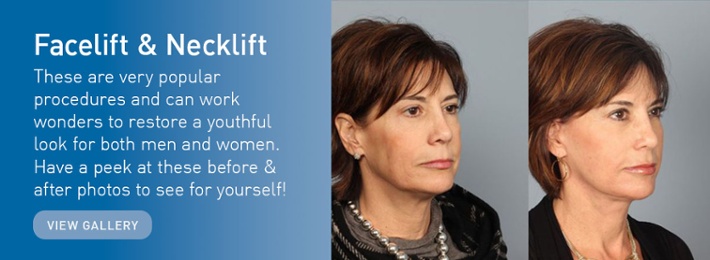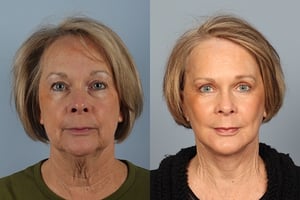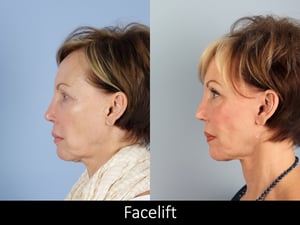
Thanks to major advancements in surgical techniques and our understanding of the aging process, modern facelifts produce results that are incredibly natural looking, unlike the more "plastic" look of years past. The different types of facelift surgeries contribute to this natural outcome by allowing surgeons to address only what they need to; no major facelifts for a patient wanting only to smooth wrinkles on their forehead. This fits beautifully with Dr. Jeffrey Raval’s philosophy: Less is More.
The facelift is no longer a one-size-fits-all procedure. Instead, we have a variety of techniques we can use to perform facial rejuvenation surgery that are tailored to meet your specific goal to look great, no matter your age.
Types of Facelifts
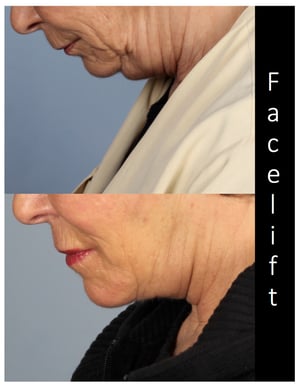
Perhaps one of the most striking achievements of the cosmetic surgery field is that a facelift no longer means altering the appearance of the entire face. For instance, a rhytidectomy is a procedure that addresses the lower third of the face -- from the mouth to mid-neck – by lifting and removing excess skin. It is meant to reverse the sagging caused by gravity as we age and smooth the wrinkles and folds caused by time and exposure to the sun.
Just as every face is different, individual plastic surgeons approach facelifts differently. Here at Raval Facial Aesthetics and ENT, we perform three basic types of facelifts.
Mini-Facelift
As the name implies, the mini-lift is a more subtle procedure. The surgeon makes a small incision near the ears, then removes excess skin and re-suspends the remaining skin and underlying tissue. This surgery is shorter, and there is less recovery time, compared to a more extensive facelift.
The mini-lift is a good choice for those in their 40s (or even late 30s) to early 50s, who have begun to develop jowls and want to refine their jawline. The mini-lift does not address the neck. It is a way to “reinvent” yourself just enough to look younger but still entirely natural. As such, it can help keep you looking younger for longer, possibly eliminating the need for a more extensive facelift.
Deep Plane Facelift
Patients in their mid-50s or older – those with more advanced signs of facial aging – may need more than a mini-lift to achieve optimal results. You may have read or heard about the MACS (Minimal Access Cranial Suspension) facelift technique, or perhaps the SMAS (Superficial Muscle Aponeurotic System) technique, both of which address the lower third of the face.
These are similar in concept to a mini-lift, but considerably more complex since they involve elevating deeper tissues as well as removing excess skin. The SMAS procedure is somewhat more extensive than MACS because it involves deeper layers of tissue. However, while Dr. Raval is skilled in both of these techniques, he now prefers to perform the newest, most advanced technique, called the deep plane facelift. The reason? More effective results!
A deep plane facelift goes below the SMAS layer to release and then re-suspend deeper muscles. That makes it an excellent choice for patients who want to improve mid face issues other facelift techniques do not include, such as nasolabial folds or “hollows” under the eyes as well as moderate to severe jowls at the jawline or moderate to severe banding or fullness in the neck area.
Dr. Raval prefers the deep plane technique because it produces the most robust, longest-lasting results. In fact, he often incorporates this technique when performing a mini-lift, to further enhance results of this “lighter” procedure. Nonetheless, if you have only minimal skin laxity, he may still recommend the SMAS option as the best procedure for you.
During a deep plane facelift, Dr. Raval makes incisions along the sides of the face at the hairline. This procedure takes longer than a mini-lift, of course. Recovery time is also longer, and the cost higher.
Necklift
Some people experience more pronounced aging on their neck than along their jawline – sagging, wrinkled skin and/or accumulations of fat. Men often complain they can’t wear a tie anymore because their neck sags over the edge of their collar. A necklift is ideal because it is specifically targeted. It rejuvenates by lifting sagging neck skin, removing fat, and tightening the underlying muscle.
You may have heard about Kybella, an injection that is sometimes confused with a necklift. Kybella only removes accumulated fat that causes a double chin, it does not address sagging skin the way a necklift does. Which is the best choice for you? Schedule a consultation with Dr. Raval to discuss your specific situation.
 What About the Rest of Your Face?
There are other surgical procedures specifically designed to improve the appearance of the eyelids (called a blepharoplasty) or the forehead (often called a brow lift). In many cases, these may also be combined with a facelift.
It’s not unusual for patients – usually older individuals with more severe signs of aging -- to desire a full facial rejuvenation. But that requires more downtime, and increased time under anesthesia can increase risks. So people who want a full facelift often choose to divide their surgery into stages.
What Does the Facelift Surgery Process Involve?
Because every patient is different, every facelift is unique. Dr. Raval may recommend a combination of techniques, or even a traditional full facelift, depending on your personal situation and goals. Because aging causes us to lose fat as well as skin elasticity, Dr. Raval may also use dermal fillers to re-plump contours or wrinkles, creating an even more natural looking “finishing touch” for your procedure. In some cases, he may also recommend a skin resurfacing treatment, which can be completed once you’ve fully recovered from your surgery.
Dr. Raval performs mini-lift, necklift, and SMAS or deep plane facelifts as outpatient procedures in an accredited surgical center. He prefers to use general anesthesia for all facelift patients. Your surgery will take between 3 and 5 hours, depending on the specifics of your procedure. In general, the process works like this:
Anesthesia
You will go to sleep and wake up to a new you. Still yourself, of course, but once you’ve recovered you will look younger, better rested, and more vibrant.
Incisions and Surgical Changes
For an SMAS or deep plane facelift, Dr. Raval will make incisions that begin at the temples and continue around the ear to the lower scalp. He will detach deep muscles and connective tissues, lift and re-suspend them to tighten the underlying foundation of the lower face.
Dr. Raval will then remove any excess skin. He may also make a small incision under the chin, if needed to remove fat under the chin or along the jawline.
Mini-lift incisions are shorter. The surgical steps are similar to those of a deep plane lift, but less extensive. Nonetheless, Dr. Raval may use the deep plane technique to ensure best results. A mini-lift does not involve the neck.
For a necklift, Dr. Raval will make incisions that start in front of the ear lobe and then wrap around the ear into the hairline behind the ear. In some cases, if only a limited neck lift is needed, he may make incisions only around the ear. He will then remove accumulated fat from the neck and jowls and trim away excess skin. He may also tighten the underlying platysma muscle.
Closing
Dr. Raval may choose to use sutures that will dissolve on their own. If not, you will need to have your sutures removed a few days after surgery. Because he is a skilled surgeon, he is able to place incisions for all types of facelifts within the hairline or natural creases around the ear. Once healed, it’s unlikely anyone will be able to notice any scars.
Following surgery, you will rest in the recovery room for about an hour while the anesthesia wears off. Then you can go home – but someone will have to drive you.
Facelift Recovery Time
 You will receive detailed, written follow-up instructions on what to do at home to care for your incision sites and to ease your recovery. Exactly how long that will take depends on the details of your surgery and your overall health. It also depends on you doing your part – it is essential to follow Dr. Raval’s instructions in every way. If you do not, you run the risk of delaying your recovery or even inviting problems such as infection.
If you were a smoker before your surgery, it is especially important that you continue cessation as you recover. Smoking can seriously hamper healing by restricting blood flow to the surgical sites.
At first, you will have one or two tiny tubes at your incisions, to help drain any excess blood or fluid. These are usually removed the next day. You will wear a special wrap around your face and neck for a few days to help minimize swelling and bruising. You may also be given medication to help relieve initial pain or discomfort.
After about a week, your stitches can be removed. You should be back to moderate exercise in a couple of weeks, and swelling should be mostly gone in about 3 weeks. If you’ve had a deep plane facelift, it may take a little longer for swelling to go down, but in most cases, facelift patients are ready to get back to normal life within about two weeks.
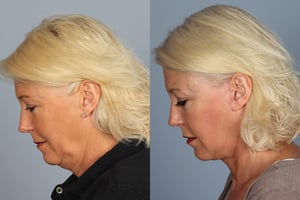
It is important to note that it may take 2 or 3 months for your face to feel entirely back to normal in terms of skin sensation and tightness. Nonetheless, you’ll start to see visible improvement soon after your surgery, and that will continue to develop during your recovery period.
Facelift Costs
There are variables associated with every surgery because your face and improvement goals are unique. The exact cost of your surgery will depend on your individual situation.
As with any surgery, the total cost comes from several sources beyond the surgeon’s fee, including:
- Anesthesia fees
- Surgical facility or hospital costs
- Post-surgery medications
You will be given detailed cost information before making your final decision to have surgery.
Most health insurance does not cover cosmetic surgery.