Chin Injections vs Chin Augmentation Surgery
Unsatisfied with the look of your jawline? We can correct and add definition to your chin through in-office chin injections or chin augmentation surgery. Read On
Raval Facial Aesthetics
3773 Cherry Creek North Drive, Suite 132
Denver, CO 80209
Phone: (303) 381-3223
Monday: 8 a.m. to 5 p.m.
Tuesday to Thursday: 8 a.m. to 6 p.m.
Friday: 8 a.m. to 4 p.m.
Saturday: 8 a.m. to 2 p.m.
every other Saturday
There are several reasons you might want chin augmentation:
These issues may be the result of genetics, a congenital deficiency, or an injury to your chin.
Cheek augmentation is most commonly used as a way to rejuvenate the aging face, restoring volume and the appearance of higher cheekbones that dissipate and cause cheeks to look flattened over time.
But it’s not just about your chin or cheeks. The way your face looks is a composite of all your features, including your bone structure, muscles and other soft tissues, and skin. If one visible feature is out of balance, it changes your entire appearance. For example, if you have a small chin, your nose may appear larger than it really is, and if your nose seems overly small, that may be because your chin is more prominent.
So while chin and cheek augmentation can work on their own (and, often, together) to refine overall facial harmony, these procedures are often performed as part of a facelift or rhinoplasty surgery to accomplish more comprehensive improvement in facial balance.


If you have a weak chin and the amount of change you wish to make is small enough, Dr. Raval may recommend using soft-tissue filler instead of an implant. Fillers are temporary, whereas an implant is permanent, but they also offer flexibility. You can more or less change when you renew the filler, and Dr. Raval can also adjust the filler amount and placement to match other changes in your face that come naturally with age.
For a surgical chin implant, Dr. Raval may first take an X-ray (digital scan?) of your face and chin to see exactly where and how much to modify the shape of your chin, based on your aesthetic goal.
This is an outpatient procedure, performed under general anesthetic or local anesthetic with sedation. During the procedure, he will make an incision either under your chin or inside your mouth, then create a pocket underneath the muscles, right in front of the chin bone. He will position the implant in the pocket and secure it to the chin bone, closing with sutures. Even with an outside incision, any scarring will be nearly invisible. As a stand-alone procedure, chin implant surgery takes about an hour.
Implants come in various sizes and shapes, allowing Dr. Raval to precisely tailor your procedure so that you get the improvement you desire with natural-looking results. Implants come in a variety of materials, too, but Dr. Raval prefers to use silicone for chin augmentation because it has the longest track record of safety.

Choose from 3 customized spa membership plans to save on BOTOX®, fillers, lasers, peels, and more—while maintaining your results with exclusive member perks!
Pick Your PlanImplants are also available for cheek augmentation, but Dr. Raval no longer uses them. Instead, he recommends filler. As noted earlier, fillers are more versatile. They are also faster and less invasive than surgery, and the cost is considerably lower.
Every invasive procedure poses certain risks. For chin implant surgery, risks are minor. The most common include:
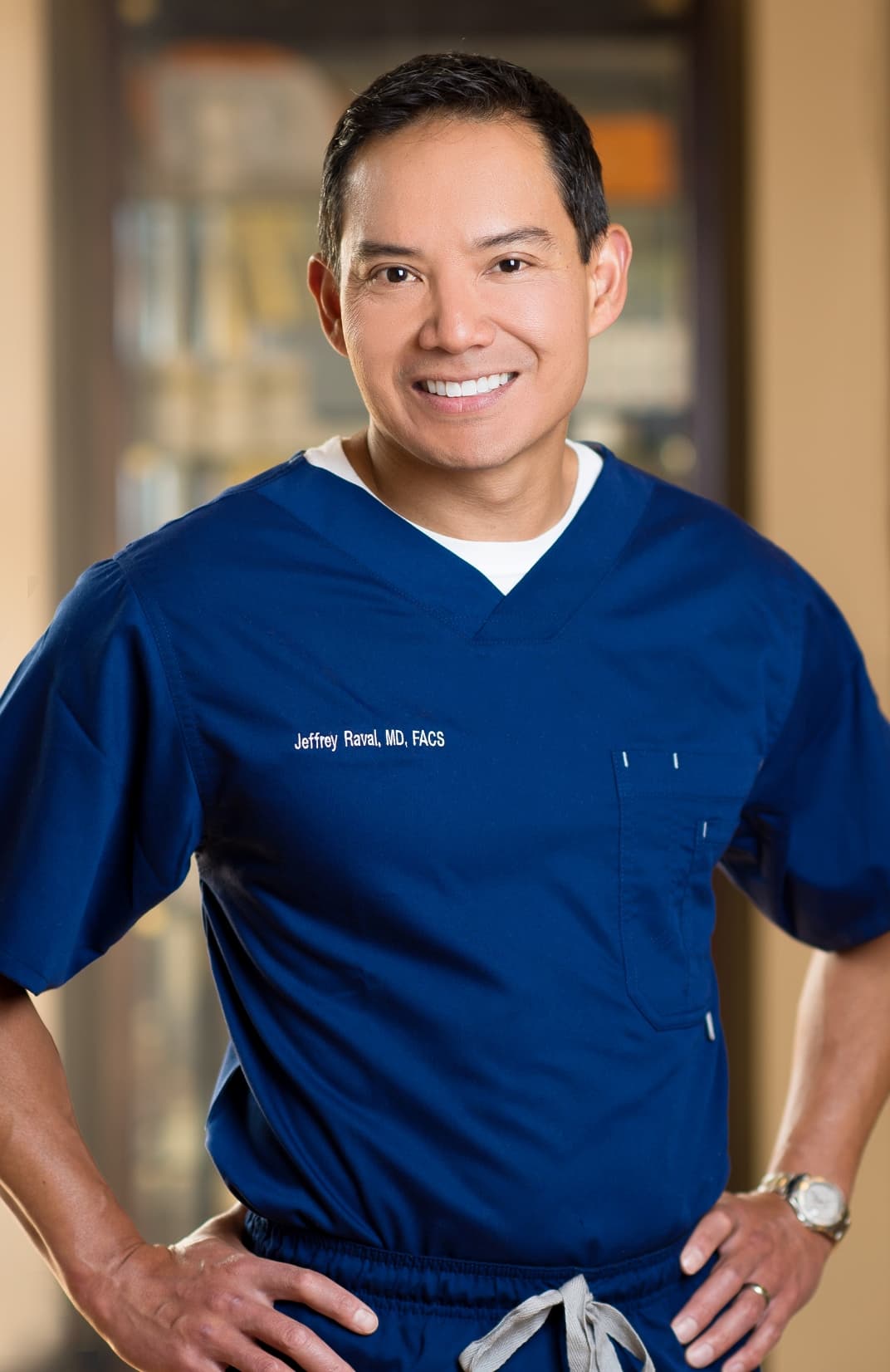
Choosing a facial plastic surgeon in Denver requires careful evaluation of training and specialization. As a double board-certified, fellowship-trained facial plastic surgeon, Dr. Raval focuses exclusively on facial procedures. His background in both reconstructive and aesthetic techniques ensures enduring results that look beautiful and natural—never overdone.
Consultations at Raval Facial Aesthetics are thorough and unhurried, with thoughtful discussion of goals, options, and realistic outcomes. From consultation through recovery, you can expect attentive follow-up, clear and honest communication, and a team committed to building lasting confidence.
Meet Dr. Raval

Following chin implant surgery, you will go home with a few stitches — protected with a bandage if the incision was under your chin. You will also receive written instructions on how to care for the procedure site – it is essential that you make sure you understand these instructions and that you follow them exactly. That way, your recovery will be fast and smooth as possible.
You can expect some swelling for about 5 days to a week, and you can likely return to work and simple daily activities within a week or less. You’ll have to wait 3-4 weeks to resume more strenuous activities.
You shouldn’t have much post-procedure discomfort, but Dr. Raval will prescribe pain medication and you can use a cold compress to help reduce initial discomfort and swelling. You will have to sleep face-up and with your head elevated for at least a week, maybe two. This protects your stitches and helps reduce swelling. You will also have to speak and chew carefully at first, to further protect your chin as it heals
With chin or cheek augmentation using fillers, you will have minimal downtime, though you should take life a little easier for the first day or two. You may experience mild swelling or bruising, but that will dissipate soon.
Because Dr. Raval tailors your procedure just for you, you can expect to see results that are natural-looking and virtually undetectable to others. Implants provide permanent results, so your new chin contour will not change over time as your face ages in other areas. Fillers are temporary because they are ultimately absorbed by the body. You will need a refresher treatment every year or two, depending on the filler Dr. Raval uses.
You will begin to see changes once post-op swelling goes down, and you should see final results within a month, or over the next few months for implants. If you have an implant, when you touch your chin, it will feel pretty much the same as your natural chin bone.
Age is not a factor when it comes to chin and cheek augmentation, as long as you are a fully-grown adult. So you may be a good candidate for one or both of these procedures if you simply don’t like the size or shape of your chin or fuller, more rounded cheeks.
That said, cheek augmentation is most often requested by patients whose cheeks have flattened with age. This is why this procedure can nicely complement a facelift. A facelift primarily addresses the aging jawline, jowl and neck to rejuvenate the lower face, so adding cheek augmentation rejuvenates the middle of the face as well.
Other factors that make you a good candidate include:
Because every surgical procedure is individually tailored, the cost depends on the details of your procedure. In general, chin augmentation at Raval Facial Aesthetics and ENT runs between $5,030 to $5,510*. This includes the surgeon’s fee as well as the surgical facility, anesthesia, medical supplies, etc. You will be given a personal estimate before you make a final decision about your surgery.
Chin augmentation procedures are considered cosmetic and are not covered by most health insurance policies. You should always speak with your insurance provider before surgery to make sure you fully understand your personal coverage.
As far as cheek augmentation, since we have moved away from surgical remediation for cheeks and towards filler injections as a solution, our pricing for cheek augmentation would mirror our filler injectable pricing.
*Pricing as of September 2019 and subject to change with time.
Restoring a more harmonious balance to your facial appearance can boost self-confidence, and that can be a life-changer. Perhaps chin and/or cheek augmentation is all you need to accomplish that. By scheduling a personal consultation with Dr. Raval, you can discuss your face and your aesthetic goals and then decide together if one or both of these procedures are right for you.
Request a Consultation